
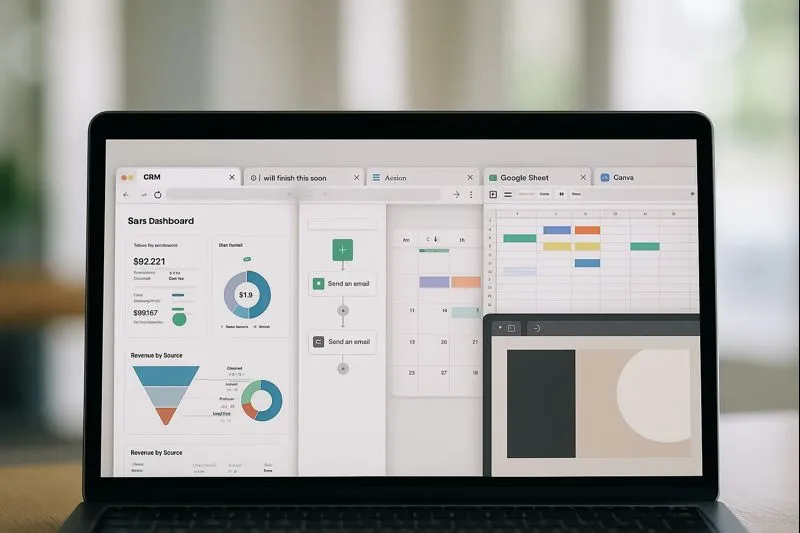
At 9:13 AM on a perfectly ordinary Wednesday, something unusual happened.
I opened my laptop, and my browser tabs were already awake.
Not spinning. Not glitching.
Just waiting in a very specific way.
The kind of silence that suggests a scheduled meeting.
A meeting I was not invited to.
A meeting about me.
1. The Tabs Formed a Committee
There they were:
- The CRM dashboard
- The Automation Setup tab is titled “I will finish this soon.”
- The content calendar
- The Google Sheet that judges me silently
- And the Canva design I have opened for weeks for absolutely no reason
They sat at the top of my screen like board members assessing the CEO.
Not angry.
Something worse.
Professionally disappointed.
The CRM tab spoke first.
If a CRM could speak, it would sound like this.
“You have a pattern of operational avoidance.”
The Google Sheet nodded in agreement.
Canva let out a dramatic sigh.
I had no counterargument.
2. They Presented Evidence
Each tab stepped forward as if presenting a case file.
Exhibit A
Forty-seven instances of “remember later” with no follow-up.
Exhibit B
A content plan that looks like it was last touched during a more optimistic version of myself.
Exhibit C
An automation setup was abandoned on step two of nine.
Exhibit D
The tab titled “Fix workflow THIS WEEK” opened nineteen days ago.
The precision was painful.
The accuracy was undeniable.
This was not a browser meltdown.
This was an intervention.
3. The Verdict Was Delivered
The CRM made the announcement.
“You are the bottleneck.”
Google Sheets added,
“You do not need more hours. You need fewer responsibilities.”
Even Canva whispered,
“Your brand deserves more structure and much less improvisation.”
When a design tool politely calls for your professional growth, you listen.
4. The Elegant Absurdity of Entrepreneurship
This was the moment I realised something important.
Modern entrepreneurs attempt the impossible.
We try to be the strategist, the operator, the designer, the content creator, the admin team, the automation expert, and the customer support representative.
We then wonder why focus feels like a luxury.
It is like conducting an orchestra while also trying to play every instrument.
Chaos becomes a personality trait instead of a warning sign.
5. The Realisation That Actually Hurt
Looking at those tabs, I finally admitted the uncomfortable truth.
I was not working intelligently.
I was working dramatically.
Dramatic work is fuelled by adrenaline and panic.
Intelligent work is built through structure and support.
One leads to burnout.
The other leads to actual scale.
My browser had seen my habits long enough to understand which path I was on.
6. The Shift
I began handing off everything that was quietly draining me.
The admin
The backend
The content pipeline
The client follows up
The CRM maintenance
The repetitive tasks that quietly steal ambition
The automation setups that never got past step two
And something changed.
My tabs stopped behaving like stressed employees.
They loaded smoothly.
They existed with purpose instead of pressure.
For the first time, my business felt supported instead of dependent on pure personal force.
7. The Final Note: My Tabs Left Me
Before I closed Chrome that day, one last message appeared.
Not literally, but in the way all honest realisations speak to you.
Your business can run smoothly.
It simply does not need to be run by you alone.
Simple.
Direct.
True.
The Takeaway
Delegation is not a motivational concept.
It is a decision.
A quiet one.
A powerful one.
When you stop trying to hold everything, everything finally has room to move.
Your tools know it.
Your business knows it.
Your future self definitely knows it.
The only question is how long you want to keep your browser running the company.
At 9:13 AM on a perfectly ordinary Wednesday, something unusual happened.
I opened my laptop, and my browser tabs were already awake.
Not spinning. Not glitching.
Just waiting in a very specific way.
The kind of silence that suggests a scheduled meeting.
A meeting I was not invited to.
A meeting about me.
1. The Tabs Formed a Committee
There they were:
- The CRM dashboard
- The Automation Setup tab is titled “I will finish this soon.”
- The content calendar
- The Google Sheet that judges me silently
- And the Canva design I have opened for weeks for absolutely no reason
They sat at the top of my screen like board members assessing the CEO.
Not angry.
Something worse.
Professionally disappointed.
The CRM tab spoke first.
If a CRM could speak, it would sound like this.
“You have a pattern of operational avoidance.”
The Google Sheet nodded in agreement.
Canva let out a dramatic sigh.
I had no counterargument.
2. They Presented Evidence
Each tab stepped forward as if presenting a case file.
Exhibit A
Forty-seven instances of “remember later” with no follow-up.
Exhibit B
A content plan that looks like it was last touched during a more optimistic version of myself.
Exhibit C
An automation setup was abandoned on step two of nine.
Exhibit D
The tab titled “Fix workflow THIS WEEK” opened nineteen days ago.
The precision was painful.
The accuracy was undeniable.
This was not a browser meltdown.
This was an intervention.
3. The Verdict Was Delivered
The CRM made the announcement.
“You are the bottleneck.”
Google Sheets added,
“You do not need more hours. You need fewer responsibilities.”
Even Canva whispered,
“Your brand deserves more structure and much less improvisation.”
When a design tool politely calls for your professional growth, you listen.
4. The Elegant Absurdity of Entrepreneurship
This was the moment I realised something important.
Modern entrepreneurs attempt the impossible.
We try to be the strategist, the operator, the designer, the content creator, the admin team, the automation expert, and the customer support representative.
We then wonder why focus feels like a luxury.
It is like conducting an orchestra while also trying to play every instrument.
Chaos becomes a personality trait instead of a warning sign.
5. The Realisation That Actually Hurt
Looking at those tabs, I finally admitted the uncomfortable truth.
I was not working intelligently.
I was working dramatically.
Dramatic work is fuelled by adrenaline and panic.
Intelligent work is built through structure and support.
One leads to burnout.
The other leads to actual scale.
My browser had seen my habits long enough to understand which path I was on.
6. The Shift
I began handing off everything that was quietly draining me.
The admin
The backend
The content pipeline
The client follows up
The CRM maintenance
The repetitive tasks that quietly steal ambition
The automation setups that never got past step two
And something changed.
My tabs stopped behaving like stressed employees.
They loaded smoothly.
They existed with purpose instead of pressure.
For the first time, my business felt supported instead of dependent on pure personal force.
7. The Final Note: My Tabs Left Me
Before I closed Chrome that day, one last message appeared.
Not literally, but in the way all honest realisations speak to you.
Your business can run smoothly.
It simply does not need to be run by you alone.
Simple.
Direct.
True.
The Takeaway
Delegation is not a motivational concept.
It is a decision.
A quiet one.
A powerful one.
When you stop trying to hold everything, everything finally has room to move.
Your tools know it.
Your business knows it.
Your future self definitely knows it.
The only question is how long you want to keep your browser running the company.